


Lessons in Letting Go in "Life is Strange"

Updated: Dec 8, 2019
Welcome back my cute caramel macchiatos~
Today we are going to be talking about...

“There’s no winning. There’s no losing. Everything simply is, based on the stories we’ve each built,”
....is what Alisha Karabinus would say is the main theme of Life is Strange in her article “Life Is… Tough: Hard Choices, Metanarratives, and a Spoiler-Lite Postmortem Look at Life Is Strange.” I couldn’t agree with her more, and if you’ve played through Life is Strange (or at least a good portion of it) I strongly recommend you read through her article, found here: http://www.nymgamer.com/?p=11840.
I just played through the first three episodes of Life is Strange this weekend, and I’ve gotta say, I went through pretty much the same judgemental, emotional, and I’ll admit somewhat spiritual backflips it seems Karabinus went through during her own play through of the game. Life is Strange almost feels like a rollercoaster, full of twists and turns that you never see coming; every choice doesn’t have a clear consequence, every question doesn’t have a true answer. It is impossible to play Life is Strange the “right way,” as I am learning during my own play through. In case you didn’t know (which, if you don’t... have you been living under a rock?), Life is Strange is a game based on choices, and every choice you make, or don’t make, drastically effects the story. And in this case, the story’s past, present and future can be altered depending on the choice you make.
Now, usually in games like this, it is easy to determine the consequences of each option. There’s the “bad guy” option, the “good guy” option, and sometimes a “neutral” option, all of which will eventually accumulate into a score that will determine your ultimate ending. Some games make this mechanic extremely obvious, such as in Atlus’s puzzle-platforming game Catherine, which features a little “angel-devil” gauge to telling you if you are playing the good-boy or bad-boy path.
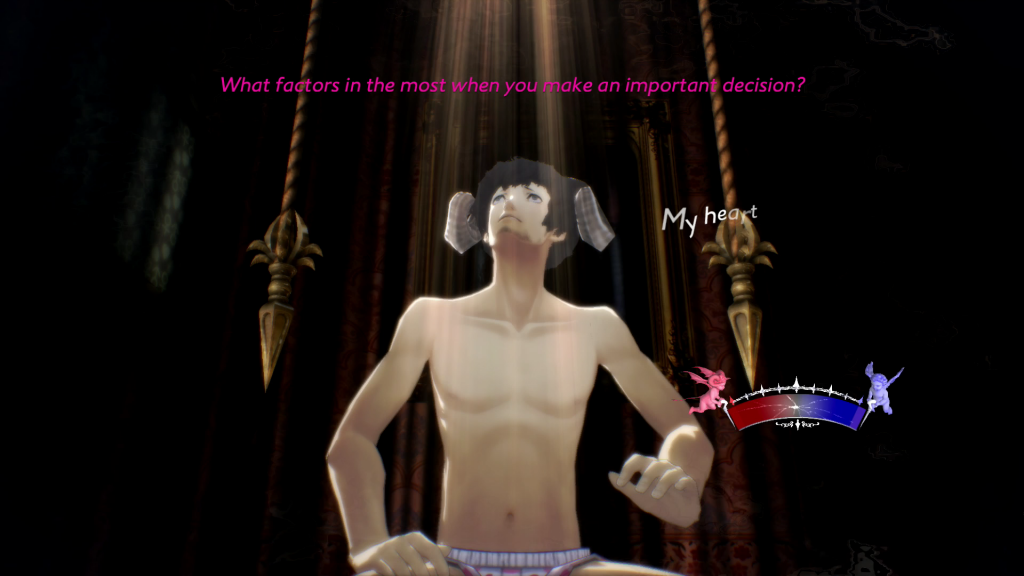
However, the action-consequence sequence in Life is Strange is much less obvious, and many times the “safest” option ends up giving you the deadliest outcome. Control is taken aware from the player, much like how it is in real life. You cannot always control other people’s actions and reactions by playing it safe or trying to appease everyone. And as you get deeper and deeper into the game’s story, it becomes clear what the true message is of Life is Strange. (Hint: Look at the quote that intro’d this post)
Ok, I’ll post it again in case you missed it. And also, because I just really love how Karabinus phrases it.
“There’s no winning. There’s no losing. Everything simply is, based on the stories we’ve each built.”
There is no winning or losing at life. Life isn’t a video game. You cannot “play” life making decisions to win. Life just simply... is. And it all comes down to the stories we’ve each created through our own unique interactions with others around us. And although this makes life much less predictable than our video game lives, it also gives us the freedom to write whatever story we want for ourselves, the ability to change our stories whenever we want, to become whoever we want to be. To accept life for what it is.
In its effort to emulate real life, Life is Strange ultimately teaches us this deeper lesson- the art of letting go.
Until next time, cutiees~
ricecakerabbit


Comments